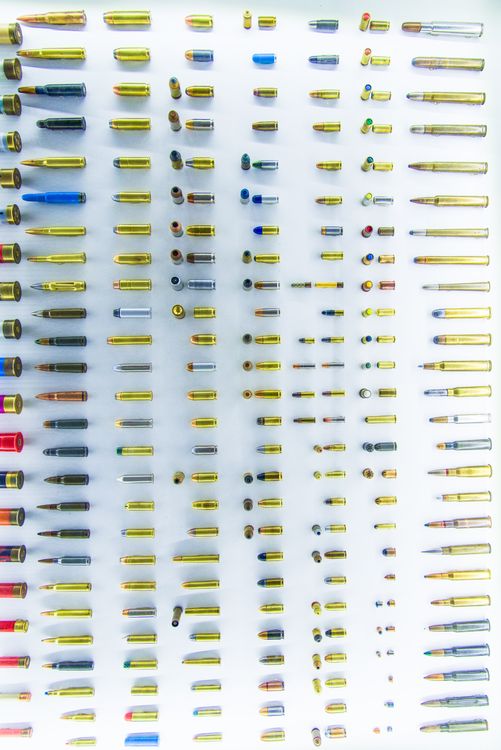
Walk into any gun store and the ammunition wall can be genuinely overwhelming — hundreds of calibers, brands, bullet types, and grain weights competing for your attention. But choosing the right ammo doesn’t have to be complicated. This guide explains everything you need to know to select the right ammunition for your specific firearm and purpose.
Step 1: Match the Caliber Exactly
The correct caliber for your firearm is stamped on the barrel and in the owner’s manual. This is non-negotiable — never chamber a cartridge not marked for your specific firearm. The consequences range from a simple failure to fire to a catastrophic firearm failure that can cause serious injury.
Important nuances to know:
- A .357 Magnum revolver can also fire .38 Special safely
- A firearm marked .223 Remington should not fire 5.56 NATO (higher pressure); a 5.56 chamber can safely fire both
- 7.62x51mm NATO and .308 Winchester are very close but not identical — consult your manual
Step 2: Understand Bullet Types
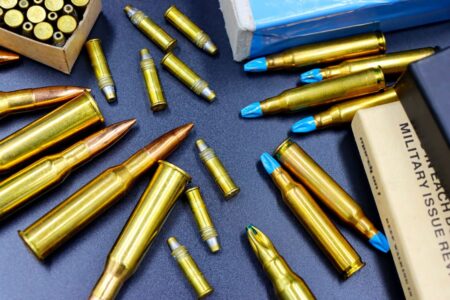
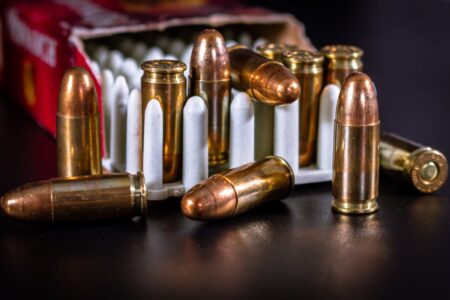
- FMJ (Full Metal Jacket): Lead core encased in a harder metal jacket. Doesn’t expand on impact. Ideal for range practice — affordable and widely available. Not recommended for self-defense due to over-penetration risk.
- JHP (Jacketed Hollow Point): Features a hollow cavity that causes the bullet to expand on impact. The standard choice for self-defense and defensive carry.
- SP (Soft Point): Lead tip exposed at the nose allows controlled expansion while feeding reliably in most semi-automatic actions. The classic hunting bullet type.
- Bonded: Core is chemically or mechanically bonded to the jacket, preventing separation on impact. Preferred for hunting through heavy bone or thick barriers.
- Frangible: Designed to disintegrate on hard surfaces. Used on indoor ranges with steel targets to prevent ricochet.
Step 3: Choose the Right Grain Weight
Grain (gr) measures bullet weight. In any given caliber, heavier bullets travel slower and hit harder at close range; lighter bullets travel faster and shoot flatter over distance.
- 9mm: 115gr (light, fast), 124gr (balanced, most popular), 147gr (heavy, subsonic)
- .308 Winchester: 150gr (flat-shooting hunting), 168gr (match accuracy), 175gr (long-range)
- 5.56 NATO: 55gr (velocity, varmints), 62gr (M855), 77gr (long-range match)
Step 4: Know Your Pressure Designations
- Standard: Normal factory pressure — safe in any firearm chambered for that caliber
- +P: Higher than standard pressure — check your firearm manual; most modern pistols handle +P
- +P+: Highest pressure — not safe in all firearms; use only if specifically approved by the manufacturer
Step 5: Match Ammo to Application
- Range practice: FMJ in the cheapest reliable option — buy in bulk to save money
- Self-defense carry: Quality JHP (Federal HST, Hornady Critical Defense, Speer Gold Dot) — don’t economize here
- Hunting: Controlled-expansion bullets (Nosler Partition, Federal Trophy Bonded, Hornady InterLock) matched to your game
Test Before You Trust
Run at least 50 rounds of any defensive or hunting load through your specific firearm before relying on it. Confirm it feeds reliably, ejects cleanly, and groups accurately. Don’t discover feeding issues when it matters most.
Shop All Calibers at TX Firearms
TX Firearms stocks a comprehensive selection of rifle, pistol, and shotgun ammunition in stock and ready to ship. Browse our full ammo selection — from practice FMJ to premium defensive and hunting loads — and find exactly what your firearm needs.